
How VR Escape Room Puzzles Work in Sunstone of Time
Why VR escape rooms feel different from flat ones: reach, weight, sound and sightlines, using Sunstone of Time's puzzle stations as the worked example.
A flat escape room gives you a cursor and a camera. A VR escape room gives you hands, a body and a room you can walk around. That sounds like an upgrade in immersion and a downgrade in precision, and it is both. The best VR puzzle games are built around the trade.
Sunstone of Time is a clean example because it uses six puzzle families and almost no text. Here is what changes when the puzzle is physical, using its stations as the case study.
If you want the game's own structure first, the Sunstone of Time wiki → has the chapter and trophy overview.
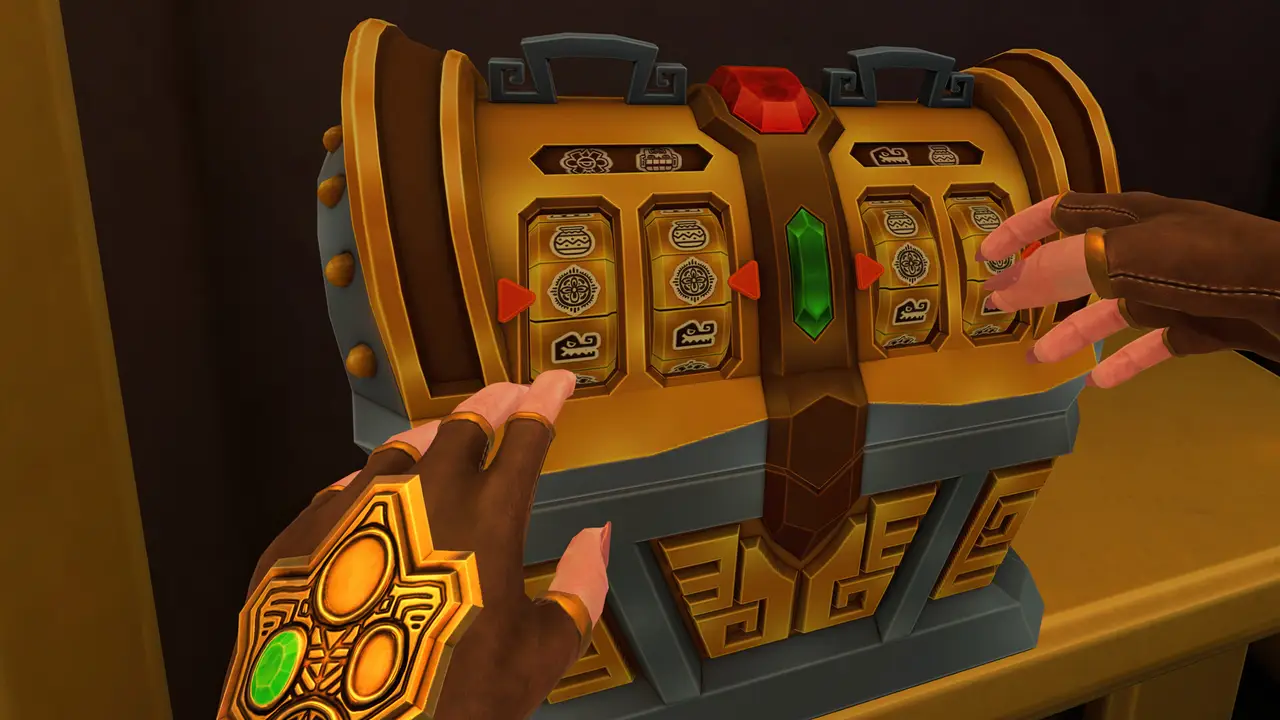
Reach replaces the cursor
In a flat game, a click is a click. In VR, the object has to be within arm's length, at a height your shoulder tolerates, and at an angle your tracking volume covers.
That constraint is a design tool. Sunstone of Time puts clues high on walls, low in bowls and behind the object you are working on, which forces you to move your body rather than your mouse. The observatory's star grid is the extreme version: the top row is genuinely awkward if you are short, and the game expects you to stand on a marked spot and rise onto your toes.
When a VR puzzle feels fiddly, it is usually a reach problem dressed as a logic problem. Crouch, step closer, change the angle, then decide the puzzle is hard.
Weight and two-handed objects
VR lets a designer make an object heavy without a stat screen. You feel it because the object does not follow your hand exactly; it lags, settles, or needs a second hand.
Sunstone of Time uses this sparingly. Most objects are one-handed and light. The ones that are not announce themselves by refusing to lift until you commit both controllers. That refusal is the tutorial: it tells you this object matters before you know why.
Flat games have to write "this is heavy" in a tooltip. VR just makes you drop it.
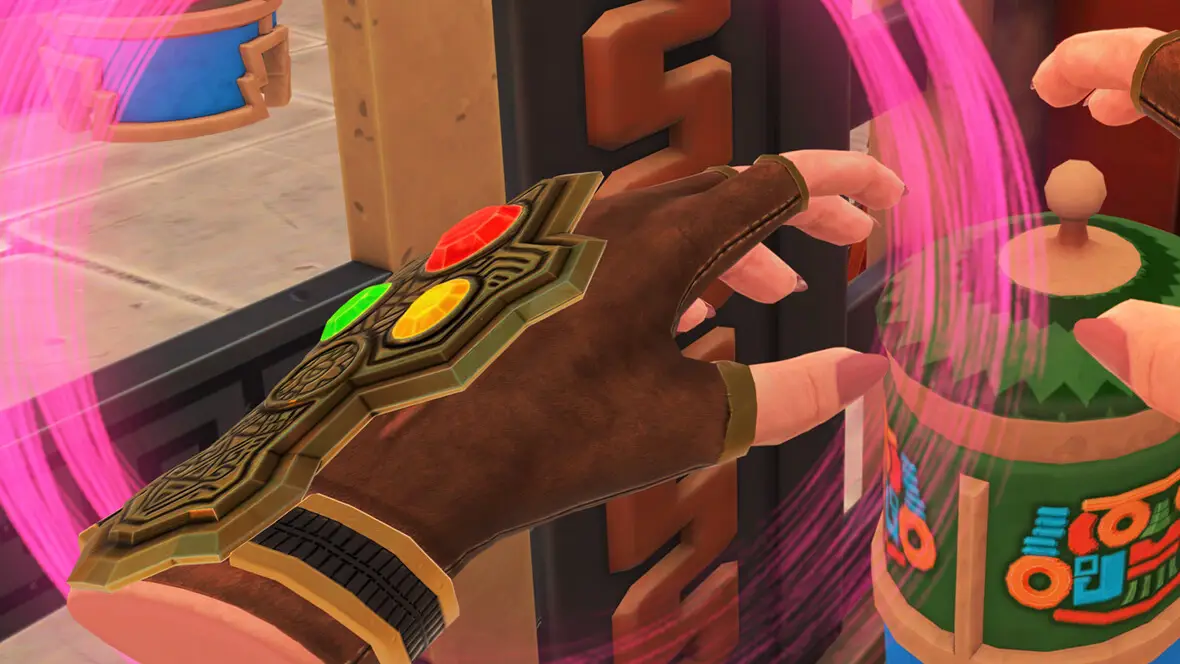
Sound carries the state
In a flat escape room, a mechanism's state is usually a visual: a light, a gauge, an animation. In VR, sound does more work because your head is inside the room and audio is spatial.
The gauge in the prison is the clearest case. Its needle clicks as it passes each mark, and setting it by ear is faster than squinting at it from an angle. The same is true of doors that open on a cycle: you can hear when the mechanism has finished.
Headphones matter more than people expect. Built-in TV audio collapses the spatial cue and turns a listenable puzzle into a visual one.
Sightlines are puzzle geometry
A flat game can hide a clue behind a camera cut. VR cannot cut; it can only put the clue where you are not looking.
So VR escape rooms hide clues with architecture. A carving on the back of a door. A symbol visible only from the far corner. A projection on a ceiling that you have to lie back to see. Sunstone of Time leans on this hard in the hidden temple, where the wall carvings are shallow enough to vanish when viewed straight on.
The practical tip: before you solve anything, walk the perimeter and look up. Twice.
When a puzzle stops making sense, step back two metres and look at the whole station. VR encourages you to put your nose against the detail, and the answer is often a pattern that only reads from a distance.
What VR still does badly
Three things. Text is worse: small glyphs at arm's length are harder to read than a monitor at the same distance, especially on fresnel lenses. Precise dials are worse: a mouse wheel beats a virtual wrist. And long sessions are worse: comfort limits how long a designer can expect you to stand.
Sunstone of Time works around all three. It uses symbols instead of text, it keeps dials chunky, and it runs six hours rather than twenty. Those are not compromises for VR; they are the reason the game is playable in one evening.
If you are shopping for more after this, the best VR puzzle games of 2026 → compares seven games on exactly these axes.
FAQ
Are VR escape rooms harder than flat ones?
Mechanically, slightly. The puzzles are usually simpler, but the interaction layer adds friction.
Do I need roomscale?
Not for Sunstone of Time. Sitting works, standing is better, and one or two interactions want a lean.
Why can't I read the small symbols?
Lens resolution and headset fit. Push the headset up so the sweet spot sits over your pupils, and raise brightness before you blame the game.
Is teleport or smooth locomotion better?
Sunstone of Time has no locomotion to speak of; you move by walking in your room. Turning is the setting that matters.
Official source: Steam store listing ↗ for the tactile, room-scale puzzle design, PlayStation Store listing ↗ for the supported play styles. Studio and release details: official Sunstone of Time site ↗.